Then and Now: Platteville Mound (or the “M”)
By Michael Lambert
As we look back in this issue over the last 100 years, one may notice that there are specific things that have significantly changed. 1926 looks and feels different than 2026. However, one thing that hasn’t changed in the last century is the shape of the rural landscape that surrounds UW-Platteville in Southwest Wisconsin.
The hills, or “mounds,” were formed over much longer periods of time—more than 10,000 years ago. Around that time, much of North America was covered in glacial ice sheets that pulverized and shaped landscapes like the Great Plains or Kettle Moraine. The Driftless Area was not affected by “glacial drift” during the last ice age, however, hence the name. So, the hills and mounds are unique. And old—geologically so.
In addition to the unique geological history, the Driftless Area also boasts the world’s largest “M.”
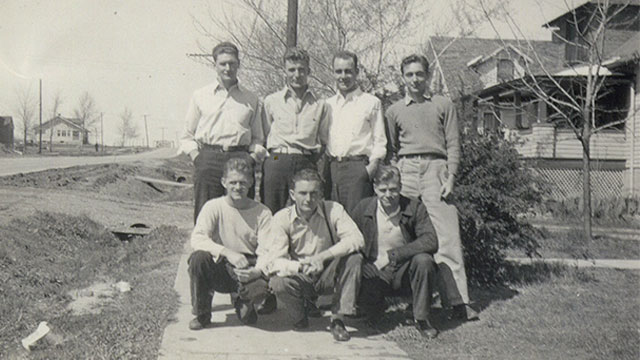
The Platteville Mound, or the “M,” began with students enrolled in the Wisconsin Mining School. The idea for the “M” was first discussed during a meeting of the Engineering Club in 1924. According to the 1926 edition of the school yearbook, “The Miner,” the Engineering Club was “the foundation of all the social, athletic, and other activities” of the school. To give a little context into other aspects of life from “The Miner” in 1926, the forward pass in football was still considered controversial and was the subject of lively discussion.;
By 1936, local landowner William Snow had given the school permission to use the land, and on one fateful snowy day, students ventured out to the location and walked the shape of an “M” into the hillside with their boots. As the snow melted slower in the tamped-down areas where they had walked, the “M” shape was visible from a distance.
This, as you can imagine, created quite a stir.
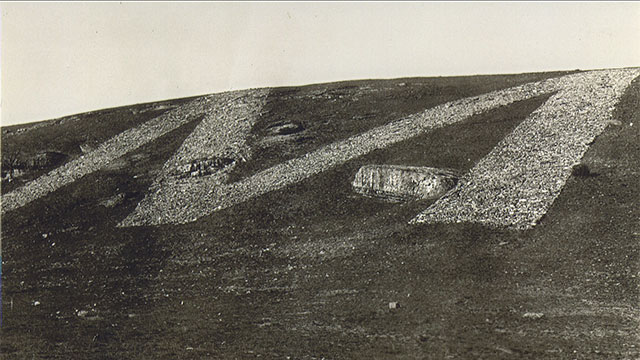
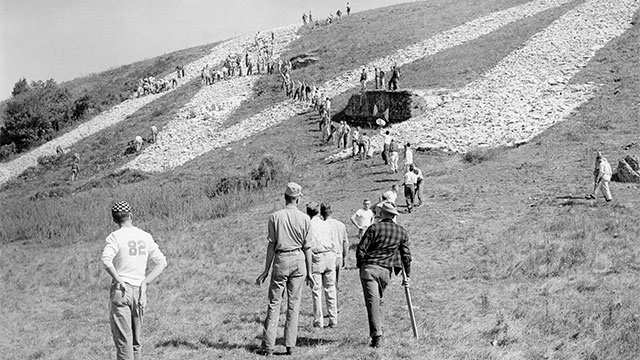
From Volume 13 of the Wisconsin Mining School (W.M.S) Geode printed in May of 1937, Platte Mound is described as “a large erosional feature about four miles East of Platteville.” The project developed beyond footprints in the snow when students “went out with surveying instruments and laid out the outlines in stakes and twine.” Director of the Mining School, H. B. Morrow, was heavily involved in the construction and vision of the 241-foot “M” that was completed later in 1937. But, according to the archive, it was students who lead the charge in the project’s completion.
“The work was directed by the Seniors, each Senior taking charge of a group of underclassmen and each group having a definite task to carry out. It was this perfect organization which enabled the student body to complete the huge task of moving the estimated 400 ton of rock in a day and a half, and the Miners lived well up to their reputation for doing things on a large scale.” For reference, the graduating class from the Wisconsin Mining School in 1937 was 11 students total. The article continues with a focus on the blasting process students used to complete the massive rock emblem. “Three types of blasting were used, mud capping, snakeholding, and blockholing, and several of the Seniors had the opportunity to handle the dynamite, place the caps and fuse, and in general prepare for the shots.”
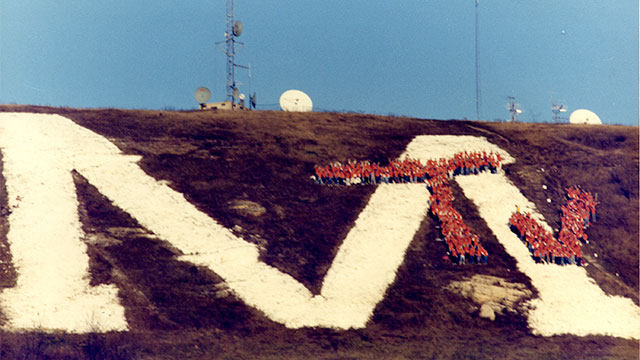
The May 1937 issue of the Geode also presents readers with more literary and poetic prose. “The rock used in the construction of the ‘M’ is a light colored limestone of which the mound is composed. This stands out beautifully against the green of the mound, and can be seen for miles. It has been seen from high points in both Iowa and Illinois, distances of 25 and 20 miles respectively, and those who have seen it from great distances say that the mound blends with the landscape, and the ‘M’ seems to stand by itself.” The unique juxtaposition of the green rolling hills and white limestone is captured in these lines and remains true of the image of the “M” today.
The limestone was eventually cemented, limed, and whitewashed, and in the process began to look more like the current version that stands on Platte Mound. The work on the “M” wasn’t necessarily over when the original construction was completed, however. From a later issue of the Geode, published in October of 1939, “a few—too few—freshmen spent an afternoon out on the Mound. They voluntarily went out there to do a little repair work on the ‘M’ which had become greatly overgrown, in fact practically obliterated by weeds.” Like all things, regular maintenance was required to keep the “M” in good shape and remain visible.
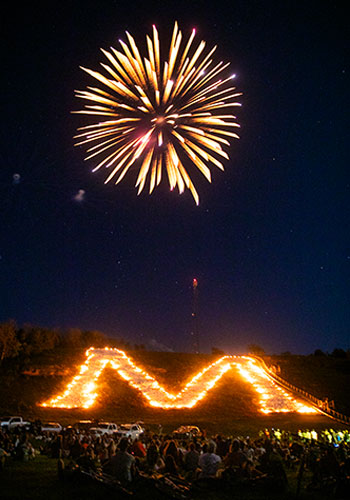
LIFE magazine covered the mound in May of 1939 and focused on the lighting of the “M” that takes place every year during homecoming. As the years progressed, a staircase was added for ease of access and safety. Other claims-to-fame include being featured on MTV in November of 1987, and being used as a key factor in the decision by Disney to select Platteville as the site for the 1998 “Hometown Parade” (Platteville was the lone city selected for the parade, and 250 members of the local community dressed in black to form Mickey’s ears around the “M” to help move the needle in their favor.) However, the essential qualities of the 241-foot symbol have remained largely unchanged.
Students like those who helped complete the heavy lifting on the original construction of the “M” would likely have a lot in common with the engineering students of today. Their vision for making their own unique mark on the world is still alive and well in the student body, though expressed in different ways.
Mining became less of the focus of the school over time, and the name of the school, itself, also changed. Looking around our campus today, though, the names of current academic buildings contain echoes of the efforts of faculty and students from the early days of the Wisconsin Mining School: Morrow Hall, like the big “M,” still stands, just like Dobson, Gardner, and Melcher (all names of faculty from the Mining School). And much like the big “M,” these buildings, too, require regular maintenance to keep from getting “obliterated by weeds.”
Issac Newton once famously said that he arrived at the scientific view that he achieved, in part, by “standing on the shoulders of giants.” In many of the same ways, the engineering students at UW-Platteville of today owe much of their knowledge to those who once walked the same snow-covered hills and mounds found a few miles northeast of campus.