

HOME Scholarship Program Builds a Foundation for Rural STEM Teachers
By Dr. Timothy Deis
What does it mean to feel at home? For the University of Wisconsin-Platteville’s HOME Scholarship Program, the answer is more than a place. It is a sense of connection, belonging and purpose. Those ideas are at the heart of an effort to prepare the next generation of mathematics and science teachers for rural schools.
Funded through an $807,650 grant from the National Science Foundation’s Robert Noyce Teacher Scholarship Program, HOME is designed to recruit and retain highly qualified mathematics and science teachers in rural and high-need school districts. The program is a collaboration among UW-Platteville’s Department of Mathematics, School of Education, university partners, educators throughout the tri-state region, and CESA #3.
HOME stands for Hone professional identity, Optimize tri-state rural resources, Mentor scholars with area teachers, and Enrich the region with highly effective math and science teachers.
During its first year, from October 2025 through September 2026, the project team transformed its initial vision into a functioning program by recruiting its first scholars and mentors, developing a seminar series, strengthening regional partnerships and introducing future teachers to the possibilities of place-based education.
Building the Foundation
The first months of HOME focused on building the structure necessary for the program to succeed. An internal and external advisory board was established, recruitment efforts began, and the project team developed the HOME Scholarship application and selection process. The team also worked with CESA #3 administrators to organize the HOME seminar structure.
By December, HOME had selected its first cohort of scholars and a group of experienced educators to serve as mentors.
The inaugural cohort included five students pursuing mathematics or science education. Four teachers from the tri-state region—representing Fennimore, Lancaster, and Platteville—joined the program as HOME Mentors.
Connecting Future Teachers to Place
 Beginning in January, scholars, instructors, and mentors participated in the HOME Seminar Series. Meeting weekly, the group explored the philosophy and practice of place-based education while developing a shared understanding of how local communities can become meaningful learning environments.
The seminar included introductions among scholars, instructors, and mentors; discussions about the importance of place in individuals’ lives; leadership training provided by CESA #3; and opportunities to learn from educators throughout the region.
The scholars also began looking at their surrounding communities through the lens of a future teacher.
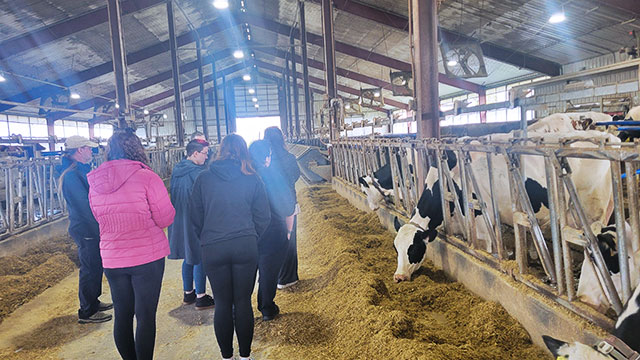
One example was a visit to the UW-Platteville farm, where scholars explored the connections between a local resource and educational opportunities. They later reported on their experiences and considered how connections to local places could be incorporated into learning.
Learning from Experienced Educators
Mentoring has been another important component of the first year.
HOME Mentors are experienced mathematics and science teachers from area schools who bring practical classroom knowledge and a connection to the communities HOME Scholars may eventually serve. In January, the mentors met with the project team to discuss effective mentoring and their role in supporting the scholars.
These relationships provide scholars with another perspective on teaching—one that comes from educators who are already working in rural schools and communities.
From Ideas to Action
By the end of the spring semester, the first HOME Scholars had moved from learning about place-based education to creating their own place-based investigations.
The spring seminar included time for project development, a meeting with the project evaluator, and presentations of the scholars’ projects in May. The project team also gathered feedback from the HOME Advisory Board to help shape the program’s continued development.
HOME Scholar Maya Benson, senior, computer science and mathematics, shared, “I loved exploring surrounding rural communities through field trips and research, and then finding ways to turn what I learned into an engaging math lesson. My mentor was invaluable in helping me make connections between my research and topics she teaches in her own math classroom.”
Looking Toward the Future
The work of HOME is ultimately about more than preparing students for their first teaching position. It is about creating a pipeline of mathematics and science educators who are prepared to contribute to rural communities and who see those communities as places where they can build meaningful professional lives.
The original HOME vision grew from a simple idea familiar to many people: the feeling of being glad to be home. The project team hopes to build on that feeling by helping future teachers develop connections to the region, its schools, and its people.
In doing so, HOME hopes to enrich not only the lives of its scholars, but also the schools and communities they will one day call home.