UW-Platteville Students Examine Midwest Infrastructure Projects
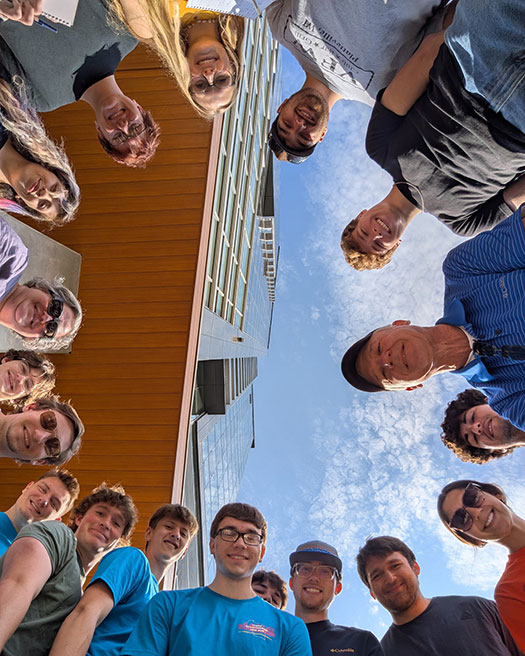
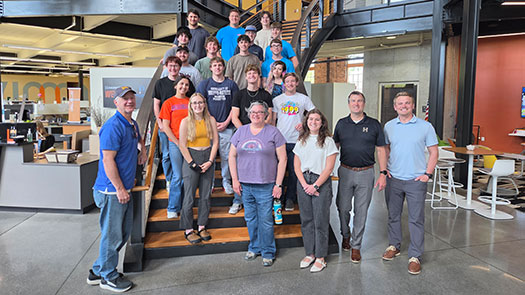
Seventeen University of Wisconsin-Platteville civil and environmental engineering students traveled more than 1,000 miles across three states in late May as part of a five-day field trip focused on regional infrastructure and the social, environmental and economic impacts of infrastructure projects.
Led by Dr. Christina Curras and Dr. Michael Penn, professors of civil and environmental engineering, the trip was funded by the National Science Foundation S-STEM grant, “Socio-cultural Place Awareness for Civil and Environmental Scholars,” or SPACES. The $1.5 million grant supports two cohorts of 12 scholars through scholarships and activities designed to develop community-minded, socially responsible civil and environmental engineers.
The field trip served as a culminating activity for the program, taking students to civil and environmental engineering projects in Wisconsin, Minnesota and Iowa. The itinerary included projects in rural, suburban, urban and ultra-urban settings and focused on how infrastructure decisions are shaped by site conditions, community needs, environmental factors and cost.
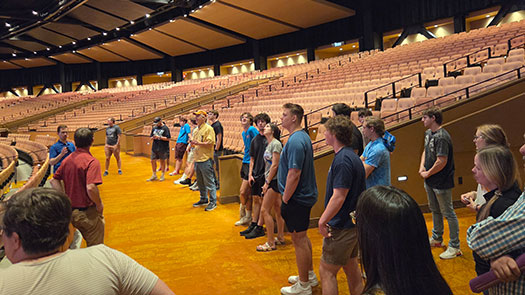
The first stop was Verona, Wisconsin, where students met with engineers and planners from the city of Verona and Epic Systems. They toured Deep Space, a subsurface auditorium with seating for more than 11,000 people, as well as active construction projects tied to Epic’s corporate campus expansion. Alumna Carley Jones, a 2016 environmental engineering graduate and municipal engineer with AECOM, discussed coordination between the city and Epic on infrastructure planning for the growing campus.
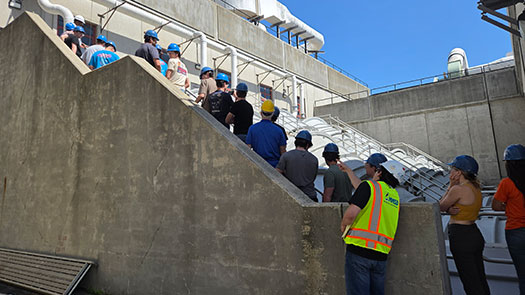
In Milwaukee, students visited Ascent, a mass timber high-rise, to learn about engineering and planning considerations for large-scale urban projects. The group also met with alumnus Tom Olejniczak, a 1997 civil engineering graduate and president of Harwood Engineering, who discussed the restoration of a historic industrial facility into office space in the Menomonee River Valley. Members of the Milwaukee Metropolitan Sewerage District guided students through several stormwater and flood control projects and led a tour of the Jones Island Water Reclamation Facility, which treats billions of gallons of wastewater each year.
In Sussex, Wisconsin, students examined a mixed-use development built on a remediated industrial site. They spoke with the village administrator about redevelopment strategies and toured a new housing development, gaining insight into planning and implementation at the community level.
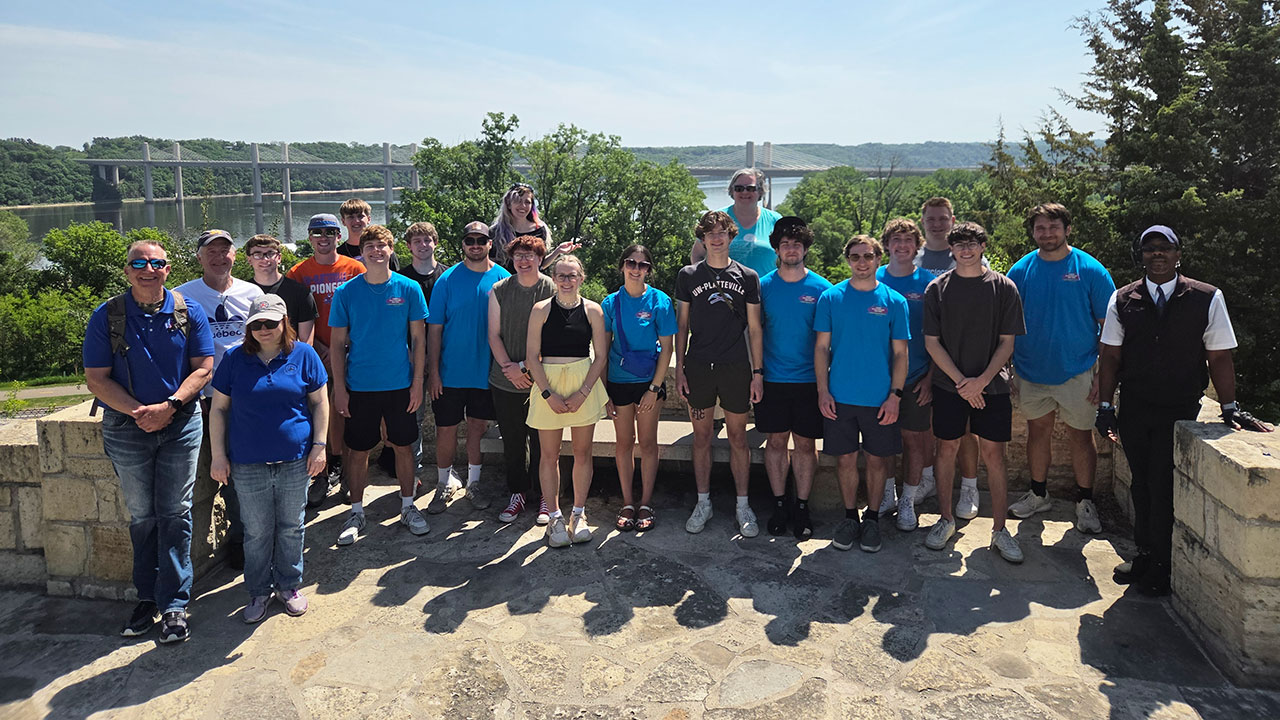
In Minneapolis, the group met with civil and environmental engineering alumni for dinner and discussion. The following day, alumni Steve Bruce, a 2001 civil engineering graduate; Teresa Davis, a 2007 civil and environmental engineering graduate; and Keena Spencer-Dobson, a 2011 civil engineering graduate, led a tour of the St. Croix River Crossing Loop Trail in Stillwater, Minnesota. They discussed community involvement, construction and design challenges related to the project. A brief stop at the St. Paul Airport introduced students to infrastructure considerations related to air transportation systems and flood management.
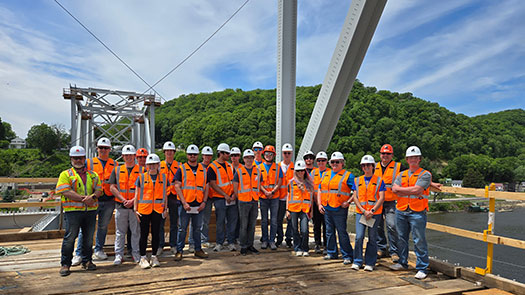
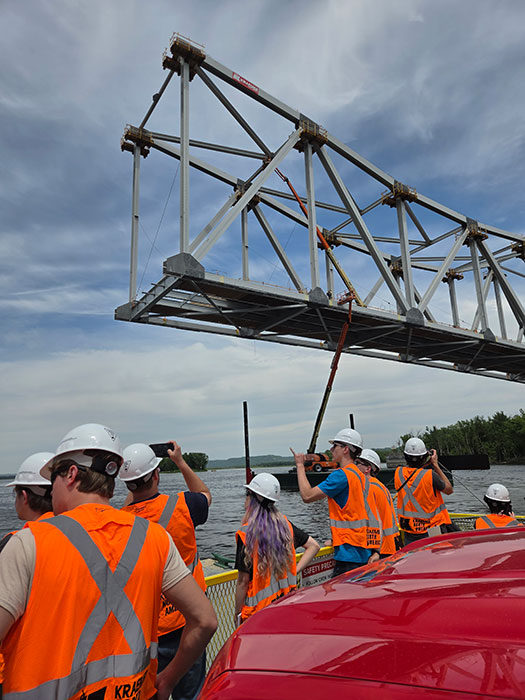
On the return trip to Platteville, the group stopped at the Mississippi River Bridge project in Lansing, Iowa, which is under construction. Alumni David Stanke, a 2000 civil engineering graduate, and Tom Ringelstetter, a 1997 civil engineering graduate, of Kraemer North America, led students onto the bridge deck and along both abutments, then onto the car ferry to view the project from multiple locations. They discussed engineering decisions and construction processes used on the project.
“I especially liked going to the Lansing-Black Hawk Bridge to be able to see the process and understand the engineers who talked about this project,” said Grace O’Melia, a senior civil engineering major. “I felt that I was actually seeing my homework come to life after learning about the basics of infrastructure this past semester.”
“The trip as a whole was an amazing experience; my favorite part was on the way back when we were able to go into the live construction area for the new Black Hawk Bridge,” said Joseph Speciale, a senior civil engineering major. “Every place we went was something new. It was also a good opportunity to connect more with classmates and my professors.”
The trip gave students examples of how civil and environmental engineering projects are planned, designed, funded and built, and how those projects affect surrounding communities.
“It’s amazing to see how many things in our lives civil engineering encompasses,” said Hayden Kincad, a junior civil engineering major. “Buildings, bridges, wastewater and stormwater, landscaping, tarmacs — it’s also amazing to see how all the different disciplines work together. Through our trip, we were able to not only see the different facets of our majors through examples of infrastructure, but also how each project requires many people of many majors and backgrounds to make it happen.”
“It was a full week,” Curras said. “Students asked thoughtful questions and stayed engaged from the first day to the last.”
For Penn, the trip was years in the making. “I’ve been wanting to do a trip like this for 20 years and finally was able to do so as part of the scholarship grant,” Penn said. “It was an opportunity to reconnect with former students and help build professional networks for our current students. Our alumni shared details about their work and experiences with students throughout the trip.”