
UW-Platteville students engineer new on-bed exercise device for rehab patients
After UW-Platteville senior Emily Milchuck's grandmother developed dementia, all she could do was sit in a chair. Slowly, her body weakened; the only way to keep her muscles active was manipulating her limbs by hand multiple times each day.
When Milchuck, a mechanical engineering major with a biomedical engineering emphasis from Pleasant Prairie, learned that Dr. Yang Chen was looking for help developing a new device to help bedridden, paralyzed and disabled patients move their bodies, she jumped at the chance. Working from Chen's concept ideas, Milchuck and fellow mechanical engineering senior Sebastian Sellek spent the summer building a prototype of a device designed to help patients perform heel-slide exercises without getting out of bed.
"As our society ages, caring for older adults and bedridden patients is becoming an increasingly significant challenge," Chen said. "These challenges affect not only individuals but also their families and caregivers, often placing substantial emotional, physical and financial burdens on them. We want to put what we have learned and the engineering skills we have developed into practice to address real human needs."
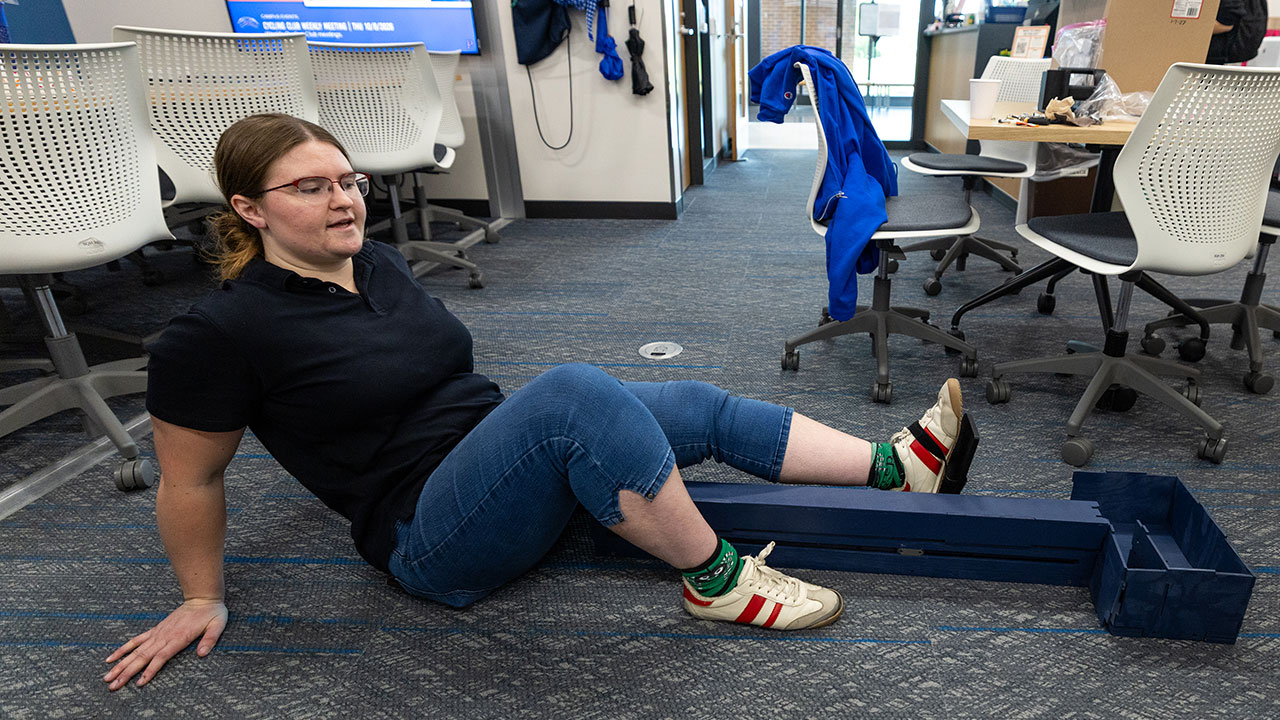
The students used 3D printers in the Huff Family Innovation Center to construct a device that resembles the horizontal base arm of a rowing machine one might find at the local gym. Patients place their feet in stirrups. A motor pulls and pushes along tracks set into the arm, extending and flexing the quadriceps, hamstrings and calves while the patient rests on his or her back. The device is designed to safely accommodate patients of all sizes, and the motor can ratchet down, allowing patients to apply more force as they grow stronger.
The machine is light enough that a caregiver or patient can lift it. If the patient can't place it on the bed independently or can't get out of bed, a caregiver simply has to roll the patient onto their side, position the beam and roll the patient back. The patient's bodyweight keeps the device firmly in place.
Milchuck said that design and construction consumed hours, with plenty of trial and error. Chen got them through it all, she said.
"Obviously with engineering, there's a lot of testing and a lot of failure," Milchuck said. "(But Chen was) always incredibly positive. Even with setbacks, she sees a way forward."
Chen hopes to bring the device to market one day. Light and easy to maneuver with a price tag in the hundreds of dollars, the machine would be an attractive alternative to clunky at-home rehabilitation devices that can cost up to $18,000, Milchuck said. The machine is already turning heads, earning Milchuck and Sellek second place in the Innovation Section at the July WiSys SPARK Symposium, a gathering of Universities of Wisconsin faculty, staff and students to support research and early-stage entrepreneurship.
Milchuck still thinks of her grandmother when she talks about the device. For her, building the machine was a mission that allowed her to channel her love of building things to overcome a challenge.
"I like solving problems," she said. "I like coming up with potential solutions. I like nitpicking all the details. I love hearing the feedback on how (the machine) will help people."
The prototype Milchuck and Sellek designed is only a start. Chen is gathering a new group of student researchers and challenging them to refine the machine to help patients perform more than just heel slides.
Is Milchuck a little envious?
"I keep seeing ways it could be improved," she said. "It's not done because I know it could be better. I just have to sit back and trust the next group."