
Move over, Mothman. UW-Platteville students dream up the Driftling as official campus cryptid
What has emerged, I think, is ... a creature that feels simultaneously strange but recognizable.
- Dr. Amanda Tucker
Move over, Mothman. Step off, Bigfoot. Bye-bye, Bray Road Beast. UW-Platteville has adopted its first official campus cryptid, a mysterious shapeshifting being known only through whispers as the Driftling.
Around 600 first-year students in the Helios Program spent the first two months of the fall semester dreaming up a creature that might haunt the campus as a means of practicing collaboration, developing storytelling skills and strengthening their sense of belonging.
Led by English professors and Helios co-directors Amanda Tucker and Katie Kalish, the students began in mid-September by scouting spooky spots on campus that a cryptid might use as its lair. Over multiple weekly sessions, they considered how the physical habitat might shape the creature's behavior, motivation and physical appearance. They also considered what monsters reveal about the communities that create them, how monster lore emerges and grows and how to communicate their final vision of the creature.
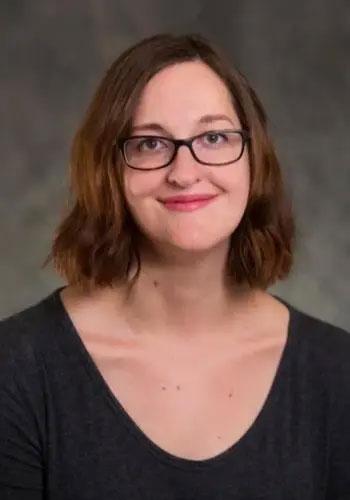
"Initially, we started with a focus on monsters, which are a pervasive cultural trope that offer a lot of different avenues for exploration and allow us to think about rhetorical symbolism and representation," Tucker said in an email. "The activity became more actively focused on cryptids due to Wisconsin's weird and wonderful history of place-based monsters. We loved the idea of first-year students collaboratively creating a university cryptid as an avenue for fostering a sense of connection and belonging to the university and to one another."
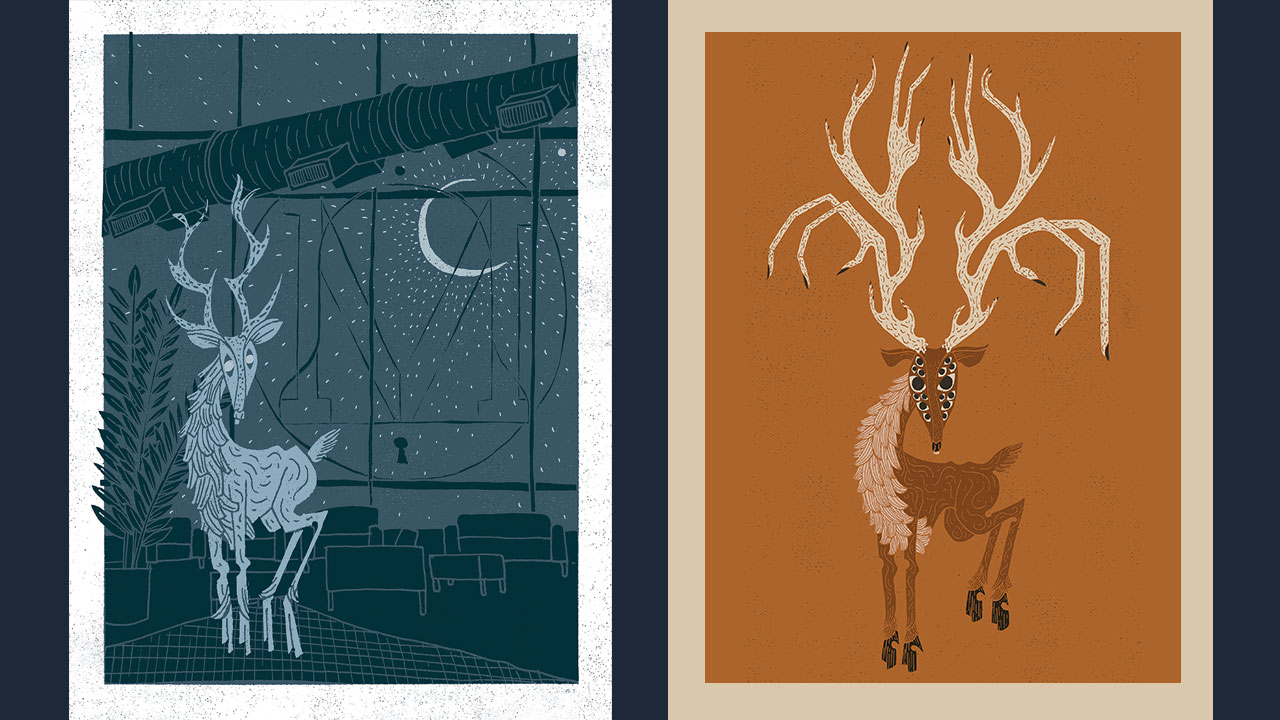
Drawing on the prevalence of deer in southwestern Wisconsin, the students decided over a number of sessions that the creature appears as a deer that stands on its hind legs. Whether or not the creature really is a deer is open to interpretation; students suggested the creature may simply take the form of a deer so it can observe students without arousing suspicion.
They settled on Ottensman Hall's basement and sub-basement as the creature's lair. Tucker noted in her project summary that the staircase from the basement to the subbasement gave some students chills. One group of students imagined the creature would keep a nest of old school supplies here; another group suggested a guardian might bring the creature discarded objects as offerings. Other students suggested the creature would haunt the woods around Bridgeway Bridge as well as corridors, stairwells and dark paths.
The students described the cryptid as lonely and looking to fit in but afraid to reveal itself. It observes students from hiding or follows them in deer form, collecting their discarded objects as a way of feeling connected to them.
The students did not name the creature. Tucker dubbed it the Driftling as a nod to the Driftless Region and the tension between the creature's desire to belong and fear of exposing itself. The students sent a description of the Driftling to Mike Bass, a cryptid illustrator and author of Frightful Folklore of North America and asked him to come up with a design for the creature.
Bass delivered two drawings. One depicts the Driftling disguised as a run-of-the-mill buck standing in front the Markee Pioneer Student Center lobby's "M" window with stars and a crescent moon in the background. The other shows the creature in its true form, a buck with 16 eyes and massive, fingerlike antlers complete with sharp black nails.
The Driftling is more than a not-so-pretty face, though. Monsters in fiction often symbolize a society's deep-rooted fears and history. Vampires, for instance, often symbolize fear of death. Werewolves represent fear over the loss of control. Tucker observed in her project summary that the Driftling embodies first-year college students' fears.
"That tension also connects ... to experiences students themselves associated with college throughout the project: transition and uncertainty, wanting connection and belonging vs. reluctance to being vulnerable/active in making connections," Tucker wrote. "What has emerged, I think, is ... a creature that feels simultaneously strange but recognizable."
WHAT TO KNOW ABOUT THE HELIOS PROGRAM:
_Helios participants can earn a Certificate of Integrated Liberal Arts by completing qualifying general education courses with an emphasis on environmental sustainability or law and conflict resolution.
_Funded in part through grants from the Teagle Foundation and the National Endowment for the Humanities, the program offers a mix of learning inside and outside the classroom through lectures, social activities and project-based learning.
_The environmental sustainability pathway offers students an opportunity to understand how humans relate to the environment, the effects of ecosystem disruption and the use and misuse of natural resources.
_Students following the law and conflict resolution pathway explore conflict and change in global contexts to gain an understanding of different justice systems.
_The Certificate of Integrated Liberal Arts can help students find jobs in a range of sectors, including education, business, the arts, engineering, law and environmental science.
_To enroll in Helios, contact your academic advisor.