
Jugglers, card tricks draw fifth graders to UW-Platteville's Math in Motion
Some of these kids are rural and they may not even have a chance to see a college. (But) these are the future designers. The future engineers of the world. We hope they're introduced to UW-Platteville and college in general.
- UW-Platteville Assistant Mathematics Professor Kathleen Volz
For nearly 200 southwestern Wisconsin fifth graders, math class Tuesday didn't start with worksheets or whiteboards. The lessons began at UW-Platteville, with cheers, card tricks and jugglers.
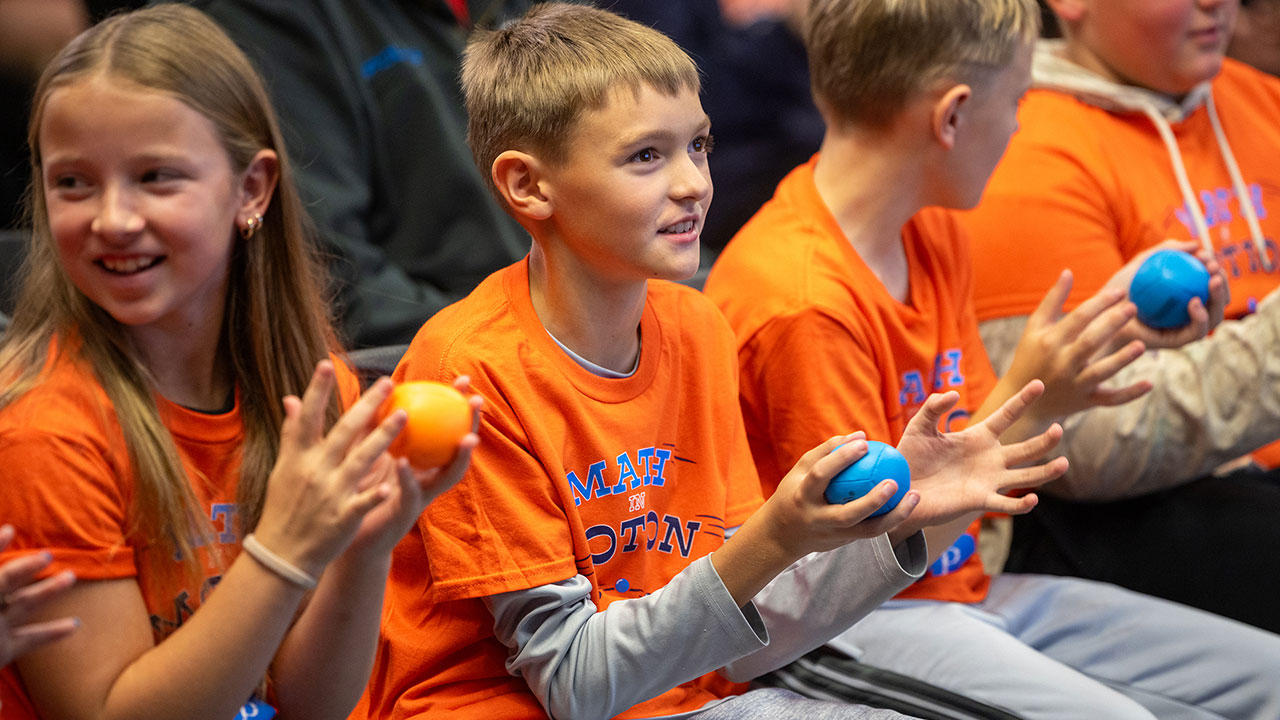
For three hours, scores of fifth graders from Benton, Shullsburg, Highland, Fennimore and Platteville sat transfixed in Ullsvik Hall's Velzy Commons as UW-Platteville math instructors walked them through card tricks and a pair of jugglers explained how they use math to map out their acts as part of the university's third annual Math in Motion event.
"It gets them excited about math at a time when they start to beat it out of you," Associate Provost Holly Attenborough, who holds a doctorate in mathematics, said as she watched the show. "It gets so test-focused that it can strip away the curiosity. Learning is more than a test. It's more than just the division you're doing in the classroom."
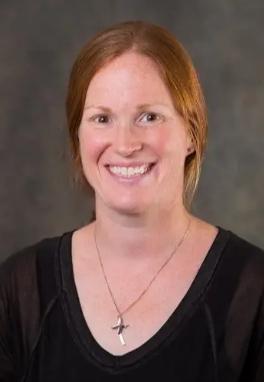
Math in Motion is largely the brainchild of mathematics professor Kathleen Volz. She got the idea after meeting freshman Tony Kaseman in one of her trigonometry classes in the fall of 2022. Kaseman, who went on to graduate this spring and become a water supply engineer, hails from a family of Madison-area jugglers, and they started talking about how math plays into sequencing juggling acts. Volz saw an opportunity to use juggling as a way to engage elementary students in the subject and a recruiting tool for UW-Platteville, and Math in Motion was born. This year Volz, fellow math instructor Chris Frayer and sophomore engineering physics major Zeke Schwartz added card tricks to the mix of activities.
"Today is about finding math in unexpected places," math professor Jason Thrun said as he welcomed the students to Ullsvik. "Math is all around us, but you guys have to be curious. You have to look for it. And if you look for it, you'll find it."
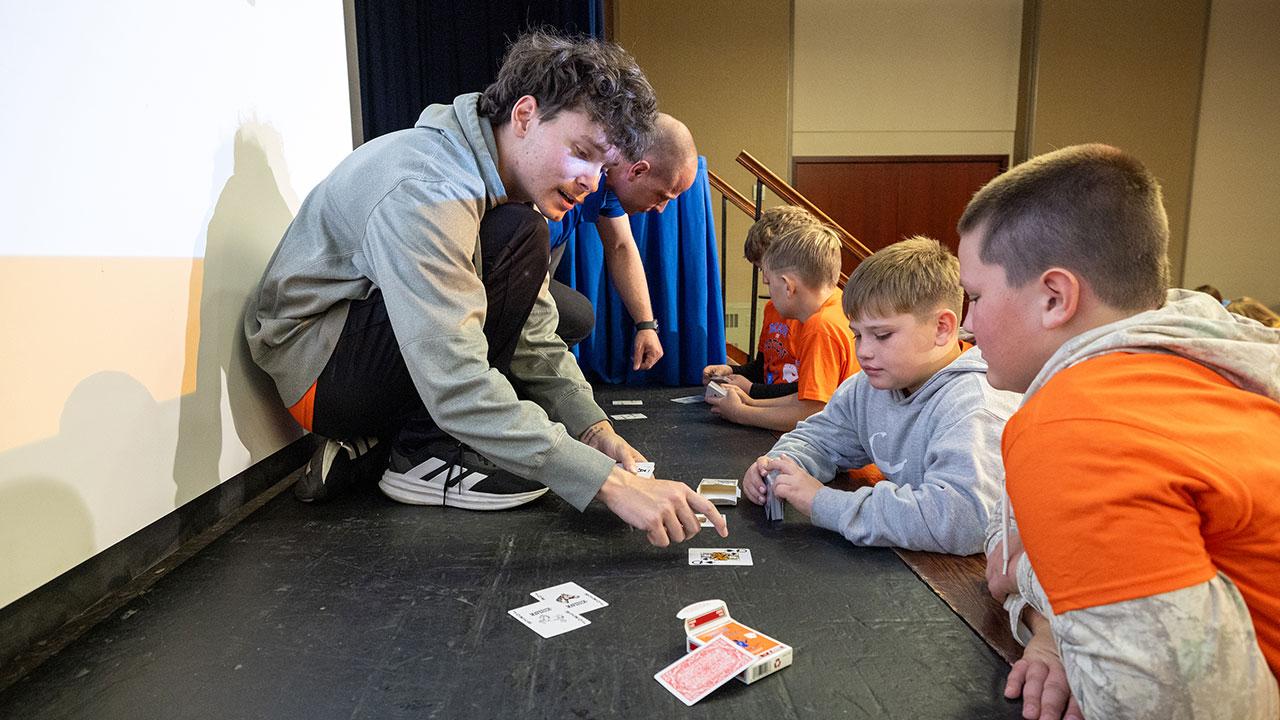
Hands shot into the air as Frayer and Schwartz began the day asking for volunteers for card tricks. Kids bounced in their seats with excitement, gaping in awe as Schwartz somehow managed to pick the cards they chose out of the deck. At one point he even turned an entire deck blank. He told the kids that he started out watching tricks on YouTube and now practices three to five hours a day.
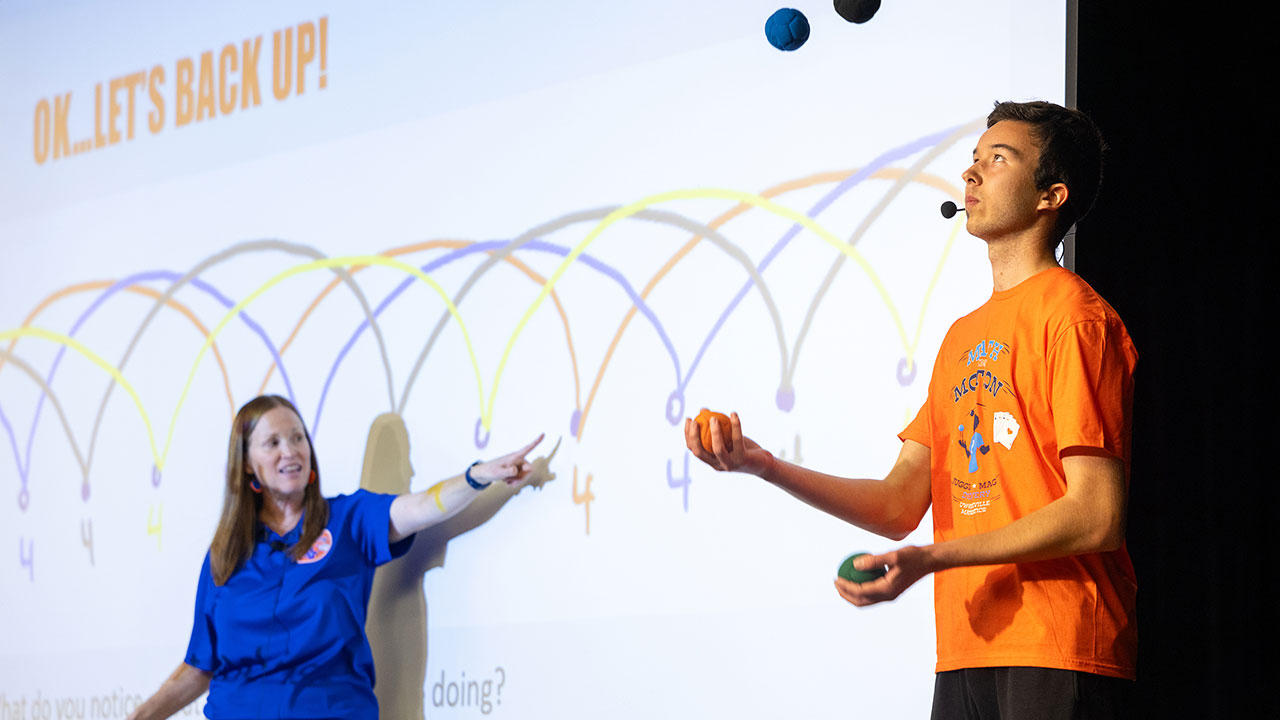
Then it was on to the juggling. As their teachers handed out balls to the kids, Volz, an amateur juggler herself, and Kaseman began explaining "the qualify," a formula judges use to determine whether a routine meets minimum requirements. It's pretty simple: you multiply the number of objects by the number of hands in play to get the minimum number of successful catches. For example, a juggler using three balls would have to make six successful catches (2 hands x 3 balls = 6 catches).
From there, Kaseman and Volz explained the siteswap concept, a numerical notation that describes how high each ball or object should be thrown and to which hand. It's similar to a receiver route tree in football. A zero-throw means someone is just holding a ball. A throw that hangs in the air for three beats is a three-throw. A throw that hangs in the air for four beats is a four-throw, and so on. Jugglers can plot out entire sequences using diagrams, tracking the path of each ball throughout the pattern.
To demonstrate, Kaseman brought his brother, Vincent, currently a sophomore at UW-Platteville, on stage to throw bowling pins, or clubs in juggler parlance, at each other as Volz projected the siteswap plots on her screen. From there the kids broke into groups to practice card tricks, juggling their complimentary balls or building geometrical shapes. After lunch the kids took a tour of campus that ended in the Huff Family Innovation Center.
The event is more than just a fun show, though. Coby Zwiefelhofer, a fifth-grade math teacher at Fennimore Elementary School, said the trip not only showed his students how math works in life but exposed them to a larger world, showing them that college can be an option.
"It's just a neat opportunity for the kids to see something different," he said. "It's an opportunity to see the campus and things outside Fennimore."
Colleges across the country are grappling with declining enrollment. The UW System's 10th-day headcount for the 2026 fall semester was down 0.7%. UW-Platteville's count was down 4.5%, largely due to the closure of the university's two-year branch campus in Baraboo this past spring.
Fewer students, naturally, means more intense competition for recruits. Volz said she hopes Math in Motion gets rural students thinking about college and a future at UW-Platteville. She recalled the campus tour that followed the first Math in Motion two years ago; as the kids walked through the Huff center, a UW-Platteville student told them that she was designing a prosthetic leg for cats.
"Their eyes just got wide," Volz said. "Two girls came up to me as they got on the bus and said 'We love college!' Some of these kids are rural and they may not even have a chance to see a college. (But) these are the future designers. The future engineers of the world. We hope they're introduced to UW-Platteville and college in general."