
UW-Platteville racing squad hosts Brazilian team ahead of international competition
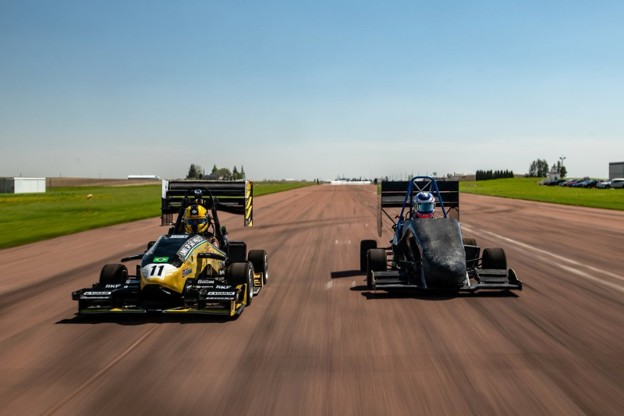
The University of Wisconsin–Platteville Pioneer Racing Formula SAE team recently hosted students from the Sao Carlos School of Engineering at the University of Sao Paulo (EESC-USP), one of the top-performing Formula SAE teams in the world, in a unique international collaboration leading up to the 2026 Formula SAE Michigan competition.
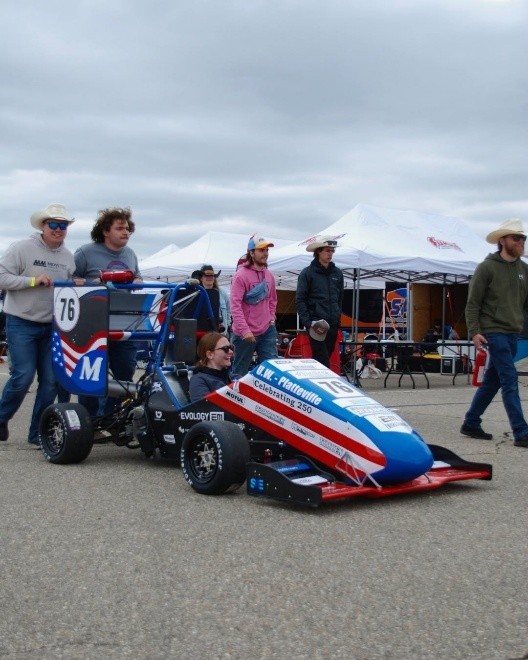
The EESC-USP team shipped its vehicle from Brazil to Platteville this spring. Team members arrived on campus in mid-April and t worked side by side with the Pioneer Racing team to assemble, test, and prepare their vehicles for competition in the Pioneer team's club space in Busby Hall for nearly a month before heading to the competition at Michigan International Speedway in Brooklyn, Michigan, in mid-May.
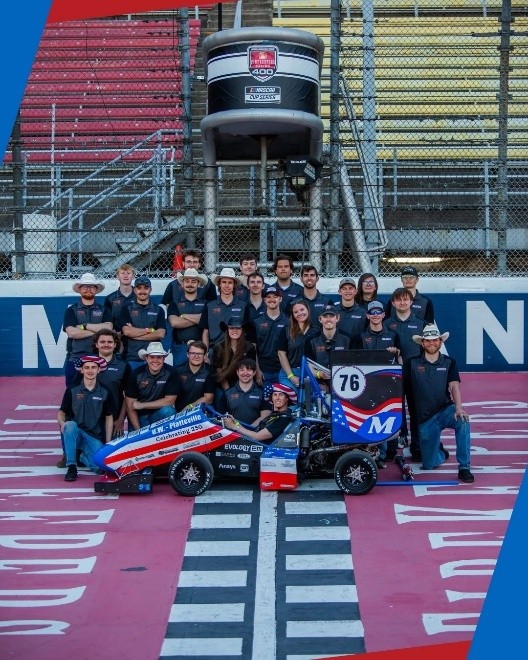
The Pioneer Racing team finished 16th out of 111 teams, their best finish ever and the top finish among non-research universities. The squad topped teams from Cincinnati, South Florida, Michigan Tech, Georgia, Clemson, Villanova and Kentucky. The Brazilian team finished ninth overall. The Universidad Politecnica de Valencia took the top honors.
“This collaboration provided a rare opportunity for our students to work alongside one of the top teams in the world,” said Dr. Jessica P.M. Fick, assistant dean of the College of Engineering, Mathematics and Science. “They engaged in real-time technical exchange while preparing for competition, gaining experience that goes far beyond what can be taught in the classroom.”
A defining aspect of the partnership was the leadership demonstrated by UW–Platteville students. Pioneer Racing members took initiative early in the process to navigate a complex set of logistical and operational challenges. Students drafted the initial host agreement, which ultimately became the foundation for the final document, outlining key considerations such as facility use, material handling, testing coordination, and how to share space and resources for building two vehicles in a space typically used for one.
“This experience speaks to the capability of our students,” Fick said. “They asked important questions, took ownership of the process, and demonstrated professionalism and leadership throughout.”
Students played a key role in hosting the visiting team—helping them get situated on campus, identifying housing options including residence halls, and ensuring they had the support they needed. Their efforts were supported by numerous offices on campus.
"Our team had no clue how they would interact with us, and from the beginning, they were nothing but kind," said Pioneer Racing member Colton Chamberlain. They joined Pioneer Racing for our weekly Culver's dinner at least once and joined us for a cookout, as well as spent time with us exploring the area. They joined us for testing sessions with both cars, where we were able to see both cars driving at once and ask each other questions."
The collaboration highlighted the global nature of engineering as students compared design strategies shaped by different constraints and resources.
“This experience reinforced that engineering is truly a global profession,” said Alex Arnoldussen, Pioneer Racing team principal. “Different experiences and approaches to problem solving can lead to ideas and solutions you may not have otherwise considered.”
For the visiting team, the experience was equally meaningful.
“This experience was much more than just an international competition for us,” said Thainá Laura de Brito Graca, EESC-USP team lead. “From the very beginning, your team welcomed us with kindness, support, and collaboration that we will never forget.”
Competing internationally also required significant technical and logistical adaptation. “In Brazil we use E100 ethanol from sugarcane [but] the competition fuel in Michigan was E85, [therefore] we had to create our own E85 mixture before traveling and recalibrate our ECU accordingly,” Graça said. “Thanks to the incredible support and structure provided by your team, five of our members were able to fully assemble the car, fire the engine for the first time, and complete a successful shakedown in only two days”
“The new insights our team has gained from EESC-USP in how to better develop our vehicle and team, as well as the friendship we gained with the Brazilian students, are things we never would have found, had we not chanced this opportunity,” said Cameron Tucker, Pioneer Racing technical director. “It was also [rewarding] to help another team get to competition and have more people to cheer for.”