
Provost grants enable UW-Platteville instructors to overhaul curriculum
As part of UW-Platteville’s commitment to fostering a transformative education, the Provost and Academic Affairs Office provides instructors and academic units with curricular improvement grants that can be used to redesign courses to better meet students' needs; update curriculum; and implement new teaching approaches that better prepare students for the workplace.
The grants provide awardees with funding and supply dollars to ensure that curriculum remains current and relevant. Here's a look at how instructors used the 2025-26 academic year awards:
-- Drs. Yanwei Wu and Xiaoguang Ma revamped four courses in computer network and cybersecurity. Changes included aligning courses with the Cisco Certified Network Associate framework to better prepare students for the CCNA exam and the CompTIASecurity+ certification, a widely recognized credential for students preparing for careers in cybersecurity. Other revisions expanded emphasis on industrial networking, which is growing more important as manufacturing systems, utilities and critical infrastructure become increasingly connected.
-- Dr. Ele Mooney modernized a computer graphics course to shift from an emphasis on low-level programming and game engines to 3D modeling, visual effects, animation and game design. Starting this year, the course will become part of a new game development emphasis in the Computer Science Department.
-- Dr. Hans Krueger overhauled the Fitness Assessment Management Course. Changes included improving online access, a new assessment tool to help students evaluate personal wellness and incorporating mediation and mindfulness into lab experiences to help students deal with stress.
-- Drs. Kevin Haertzen, Leonida Ljumanovic and Camille Schuetz redesigned a class that supports students who withdraw from calculus courses by helping them rebuild essential math skills. Enhancements ranged from a new workbook with guided practice and solutions to a new assessment system requiring students to demonstrate conceptual understanding.
-- Drs. Laura Dev, Frank King and Dong Isbister created a new cultural competence certificate available this fall. The certificate's 13-credit requirement will be embedded in general education requirements and a one-credit cultural competency course. The certificate will help students show employers that can think critically and communicate with people outside their world views and identities, helping them navigate a diverse society and giving them an advantage in the workplace.
-- Dr. Erin Anderson redesigned experiences in the School of Education's Introduction to Inclusion course, a state-mandated course designed to familiarize teacher candidates with approaches in special education. The grant funded the purchase of a range of inclusive classroom tools, including weighted pencils, visual timers, pencil grips, adapted scissors, wobble stools and assistive technology such as a C-Pen Reader, a handheld device that scans printed text and reads it aloud. A survey of the 124 students who used the tools found that 40 percent of respondents had never used such tools before, with 95 percent saying they planned to use similar tools in their own classrooms.
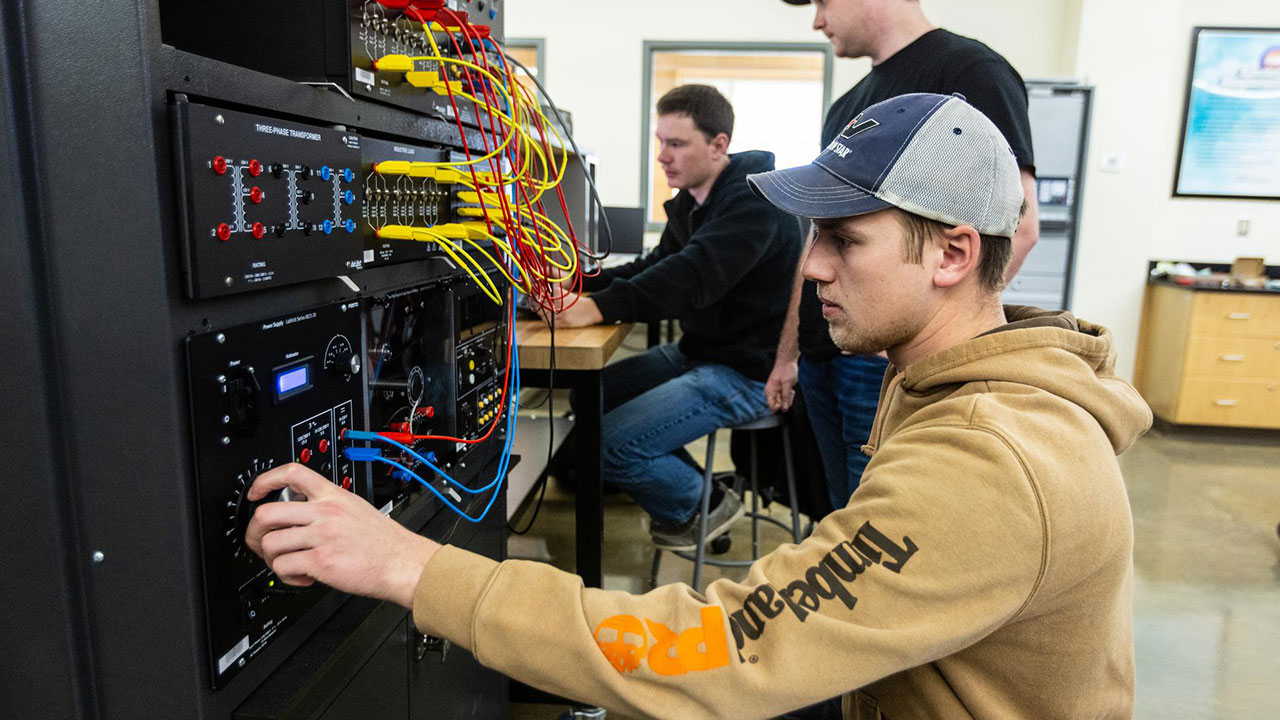
-- Drs. Jorge Camacho, Yang Chen and Paulo Yu Giving developed new experiments for students taking a mechanical and electrical engineering lab course hands-on experience with signal sampling and filtering. The first experiment centered on aliasing, a phenomenon where a signal is sampled incorrectly. Students were asked to look for examples of aliasing in the real world; they reported wheels that appeared to be rotating backward and helicopter blades that looked motionless while moving. Instructors also required students to experiment with analog filters, which remove unwanted frequency information from data. Instructors reported that students appreciated the straightforwardness of the experiments and said the work helped them understand important engineering concepts.