
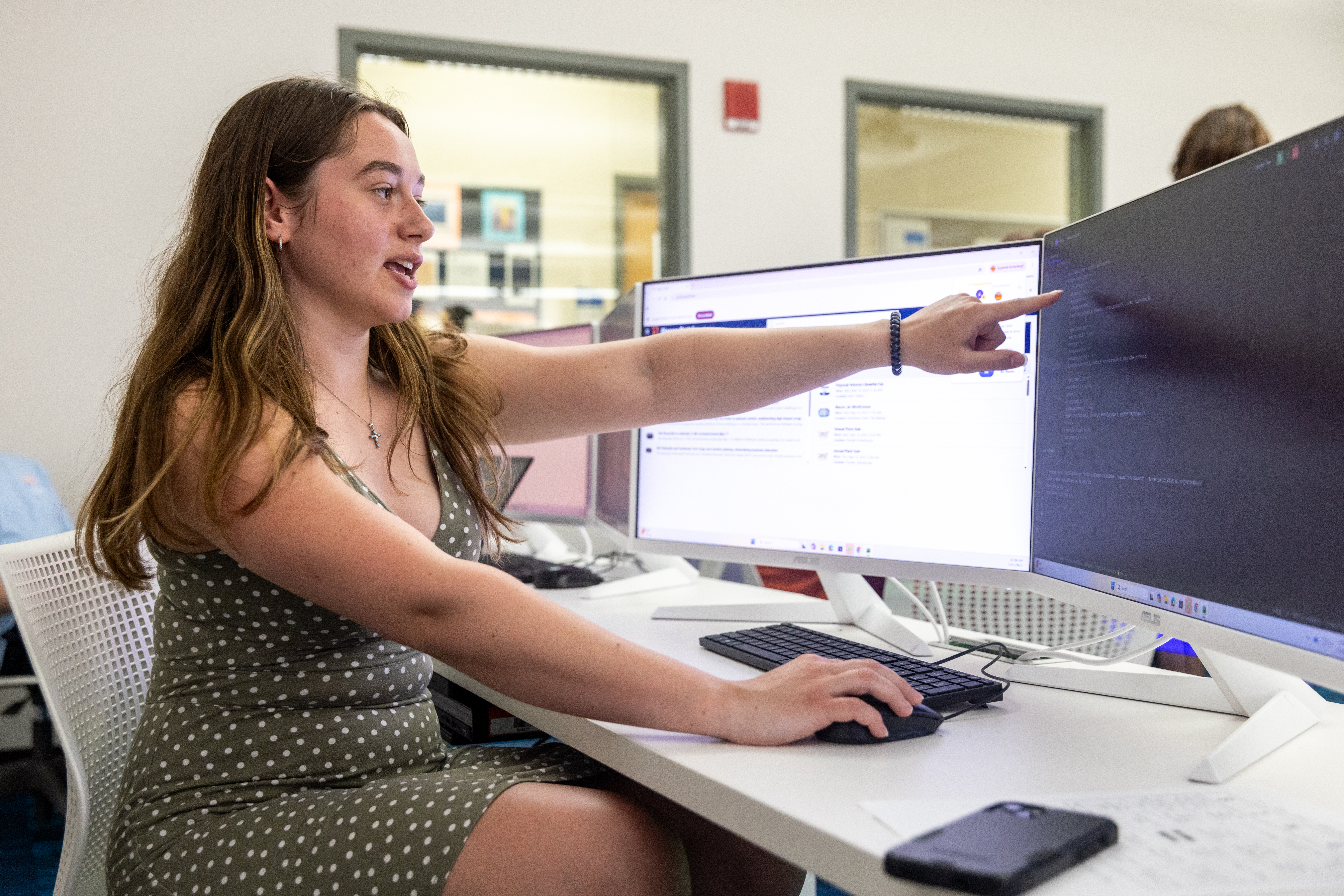
AI in Practice: Preparing Students for the Future Workplace
In engineering, the gap between theory and practice is narrowing. While the world of ideas remains foundational, real-world problem-solving increasingly demands a working familiarity with emerging tools such as Generative AI.
Dr. Philip Parker, Dean and Professor, College of EMS, recognizes this shift. Reflecting on past technological transitions, he recalls the resistance to digital photography: “It won’t replace film,” many claimed. Today, he sees similar skepticism around AI. “We tend to focus on the errors that AI is still making and breathe a sigh of relief, but the speed at which these tools are developing and improving is truly remarkable.”
This raises an important question: What will engineers contribute in an era where AI automates routine tasks? Parker emphasizes soft skills, communication, and creative problem-solving—competencies traditionally developed outside engineering classrooms.
Dr. Amanda Tucker, Professor, English and Co-Director of the Helios Program for the Integrated Liberal Arts, is also aware of the need to embrace these new tools to help prepare students for their lives outside of the classroom. During an event titled, “AI and Human Creativity,” Helios Program students were tasked with using generative AI tools to create a superhero character. Working in small groups in Ullsvik Hall, more than 600 students used AI tools to create novel superhero characters with unique superpowers, high-resolution images, and full backstories. Collaboration among student groups allowed them to explore new tools in a low-stakes, team-focused setting.
Dr. Mehdi Roopaei, Professor, electrical and computer engineering, also focuses on helping students transition successfully into the future workplace. He emphasizes that the workplace of tomorrow will require familiarity with generative AI as a key skill, and for Roopaei, this starts with developing what he calls an “AI mindset.”
“An AI mindset means viewing AI not just as a tool for generating content, but as a thinking partner—something that can collaborate with students to spark innovation, offer insights, and help them explore ideas more deeply.” An AI mindset, in other words, allows students to view AI not as a shortcut, but as a catalyst for deeper learning.
Of course, with such capabilities come ethical concerns. Questions around authorship, originality, plagiarism, bias, and privacy are very real.
“These aren’t reasons to avoid AI—they are reasons to educate about it,” he explains. To maintain academic integrity, we must proactively embed AI ethics into our curricula.
“In short, maintaining academic integrity in the AI era means equipping students not just with knowledge, but with judgement,” he explains. “It’s about building an educational culture that embraces new tools while holding firmly to the values of honesty, accountability, and critical thinking.” In this way, Roopaei sees AI as a potential partner in education—not a threat to it.
As the workplace evolves, so must engineering curricula. Project-based learning, simulations, and problem-solving rooted in real-world challenges will form the backbone of this shift. While it may be difficult to imagine what the future holds, helping students successfully navigate the world of tomorrow begins with adaptation, empathy, and a continuous reexamination of what makes us human.