
2025 Economic Impact Report
Executive Summary
This study, conducted by the UW-Whitewater Fiscal and Economic Research Center (FERC), explores and quantifies the economic impact of the university on our graduates and on the tri-state region, the state of Wisconsin, and the local region. While many studies demonstrate the wide-ranging positive socio-economic impacts of higher education, this work focuses specifically on the financial impact of UW-Platteville.
In doing this analysis, FERC considers three factors:
- The financial benefits of having a UW-Platteville degree, factoring in increased earnings, the cost of attendance, and opportunity costs of attending.
- The impact of increased alumni earnings on the tri-state, state, and local economies.
- The impact of institutional operations and current student spending on the local economy and state.
UW-Platteville alumni’s annual income, $98,175, is more than twice that of the average individual of a similar age with only a high school degree, $46,2081. In addition, UW-Platteville alumni net over $500,000 in lifetime returns from their bachelor’s degree, the second-highest in the Universities of Wisconsin.2
The additional income earned by UW-Platteville alumni generates $660 million per year in economic activity in the tri-state (Wisconsin, Illinois, and Iowa) region, with additional tax revenue of $99 million per year.
Focusing on Wisconsin alone, an estimated 60% of the 30,000+ UW-Platteville alumni still reside in Wisconsin, crucially strengthening Wisconsin’s labor market. These Wisconsin residents generate an additional $551 million in economic output, delivering an additional $83 million of tax revenue to the State.
UW-Platteville operations generate $255 million of economic output annually. Additionally, UW-Platteville students actively living and learning in Platteville and Grant County generate $42.7 million in yearly economic activity. Altogether, UW-Platteville supports 1,585 jobs and leads to $297.7 million in economic activity yearly in the local region. The annual state tax revenue resulting from the economic activity of operations and current student spending is $15.5 million.
The State of Wisconsin realizes $98.5 million of annual tax revenue due to the economic impact of UW-Platteville alumni, students, and operations. This represents an ROI of 119% on the $44.9 million (FY26) of GPR allocation to the institution. In other words, for every $1 the state invests in UW-Platteville, the state receives an estimated $2.19 in tax revenue.
Methodology
Data Sources
The FERC and UW-Platteville conducted a survey in Spring 2025 of all alumni with a known email address. 1,440 alumni responded. The UW-System Accountability Dashboards and Board of Regents of the University of Wisconsin System reports also provided budgetary and enrollment data which FERC used within an IMPLAN analysis.
IMPLAN
To calculate the impact of economic activity in the region due to UW-Platteville’s operations, an IMPLAN input/output (I/O) model was created by FERC. IMPLAN (short for “impact analysis for planning”) is an economic analysis software system used to determine the overall economic impact of initial spending on the economy. The IMPLAN model uses data gathered in FERC’s research to estimate the extent to which different spending categories affect the local economy in terms of direct, indirect, and induced effects. This input/output (I/O) model provides a means to capture and measure these effects.
There are three ways in which these effects are interpreted: in terms of output, employment, and labor income. Output represents the total value of production, the employment industry-specific mix of full-time, part-time, and seasonal employment. It is an annual average that follows the same definition used by the Bureau of Labor Statistics and the Bureau of Economic Analysis. Labor Income includes employee compensation (wages, salaries, and benefits).
Direct Effect
Direct effects are the set of expenditures applied to the I/O multipliers for an impact analysis. It is one or more production changes or expenditures made by producers/consumers as a result of an activity or policy (in this case, UW-Platteville’s operations, current student spending, and alumni spending). Direct effects can be positive or negative.
These initial changes are determined by an analyst and demonstrate the result of an activity or policy being analyzed. Applying these initial changes to the multipliers in IMPLAN will then display how a region will respond economically to them.
Indirect Effect
Indirect effects are the business-to-business purchases in the supply chain taking place in the region that stem from the initial (UW-Platteville) input purchases. As the industry specified spends their money in the region with their suppliers, this spending is shown through the indirect effect.
Induced Effect
Induced effects are the values stemming from household spending of Labor Income, after removal of taxes, savings, and commuter income. The induced effects are generated by the spending of the employees within the supply chain of the businesses impacted by indirect effects.
Examples
As a hypothetical example to demonstrate the impact of student spending: UW-Platteville had 5,684 undergraduate students on the Main campus in the Fall of 2025. Most of those 5,684 students choose to eat pizza at local restaurants. As a result of that demand, the local pizza parlors scale up operations. The economic impact of the pizza parlors’ increased business is Direct Effect. Those pizza parlors now also need more cheese to make the extra pizzas consumed by students. Local cheese suppliers scale up production to meet this demand. The economic impact of increased cheese production is Indirect Effect. Finally, both the pizza parlors and the cheese suppliers employ more local residents to respond to the increased demand. These individuals spend their labor income in the community. The increase in economic impact of these employees due to increased pizza and cheese demand is Induced Effect.
Another example helps demonstrate the impact of alumni earnings through the IMPLAN model. UW-Platteville graduate Josie is now eight years past graduation. She is employed as a civil engineer in Madison, earning $104 thousand per year. Josie decides that it’s time to take up the woodworking hobby she’s always been curious about. Josie goes to her local retailer and, using the additional income she earns because of her degree, buys the best Milwaukee battery operated combo tool kit available. Josie has UW-Platteville alumni friends that also shop for Milwaukee Tools for their hobbies. The revenue and jobs created for local retailers from these purchases are measured as Direct Effect. These sales then cause retailers to order from Milwaukee Tool Company and re-stock the shelves. This increased revenue and jobs for Milwaukee is measured as Indirect Effect. The additional staff at local retailers also spend money in the economy. This is measured as Induced Effect.
The Financial Value of a UW-Platteville Degree
As students and their families face decisions about whether to invest in higher education, it’s important they be equipped with information that speaks to the impact of that investment, such as the earnings potential of those with a college degree vs. high school graduates.
FERC’s findings conclude that a UW-Platteville degree is an exceptional investment. Graduates across disciplines are thriving in their careers and have made a rapid return on their investment, as compared to the national average. The average income of UW-Platteville graduates from the classes of 1982-2015 is $98,175. In comparison, the income of 25–54-year-old high school graduates adjusted to inflation as of 2025 was $46,208. UW-Platteville alumni, on average, made more than twice as much income. 3
In addition, UW-Platteville alumni earn an additional $500,000 over their lifetime after earning back the cost of their degree, the second-highest return on investment in the Universities of Wisconsin.4
UW-Platteville's Financial Impact on the Tri-State, State and Local Economies
Financial Impact of Alumni Earnings
The additional income that UW-Platteville graduates earn due to their degree has a large positive economic impact. The average annual income of an alumnus was determined through our alumni survey. From this, the FERC netted out the income earned by high school graduates according to the U.S. Census Bureau to determine the economic impact of additional income due to holding a UW-Platteville degree.
In addition, the U.S. Consumer Expenditure Survey shows that consumers spend 71% of gross income on housing, food, transportation, clothing, and other consumer expenditures. Increased spending in these categories due to enhanced earnings has far-reaching economic effect - beyond the alumnus' own workforce participation. The additional economic activity generated by UW-Platteville graduate spending also creates demand for additional jobs in the workforce in a variety of industries.
Impact of Alumni earnings on the Tri-State region
72% of UW-Platteville alumni survey respondents (which represent 21,600 of UW-Platteville’s 30,000+ graduates) live and work in the Tri-State region of Wisconsin, Illinois, and Iowa. The additional spending power of these individuals generates $660 million of impact to the Tri-State economy every year, creating 3,910 jobs.
| Type of Effect | Employment | Labor Income | Output |
|---|---|---|---|
| Direct Effect | 2,500 jobs | $110,000,000 | $360,000,000 |
| Indirect Effect | 680 jobs | $45,000,000 | $168,000,000 |
| Induced Effect | 730 jobs | $42,000,000 | $132,000,000 |
| Total Effect | 3,910 jobs | $197,000,000 | $660,000,000 |
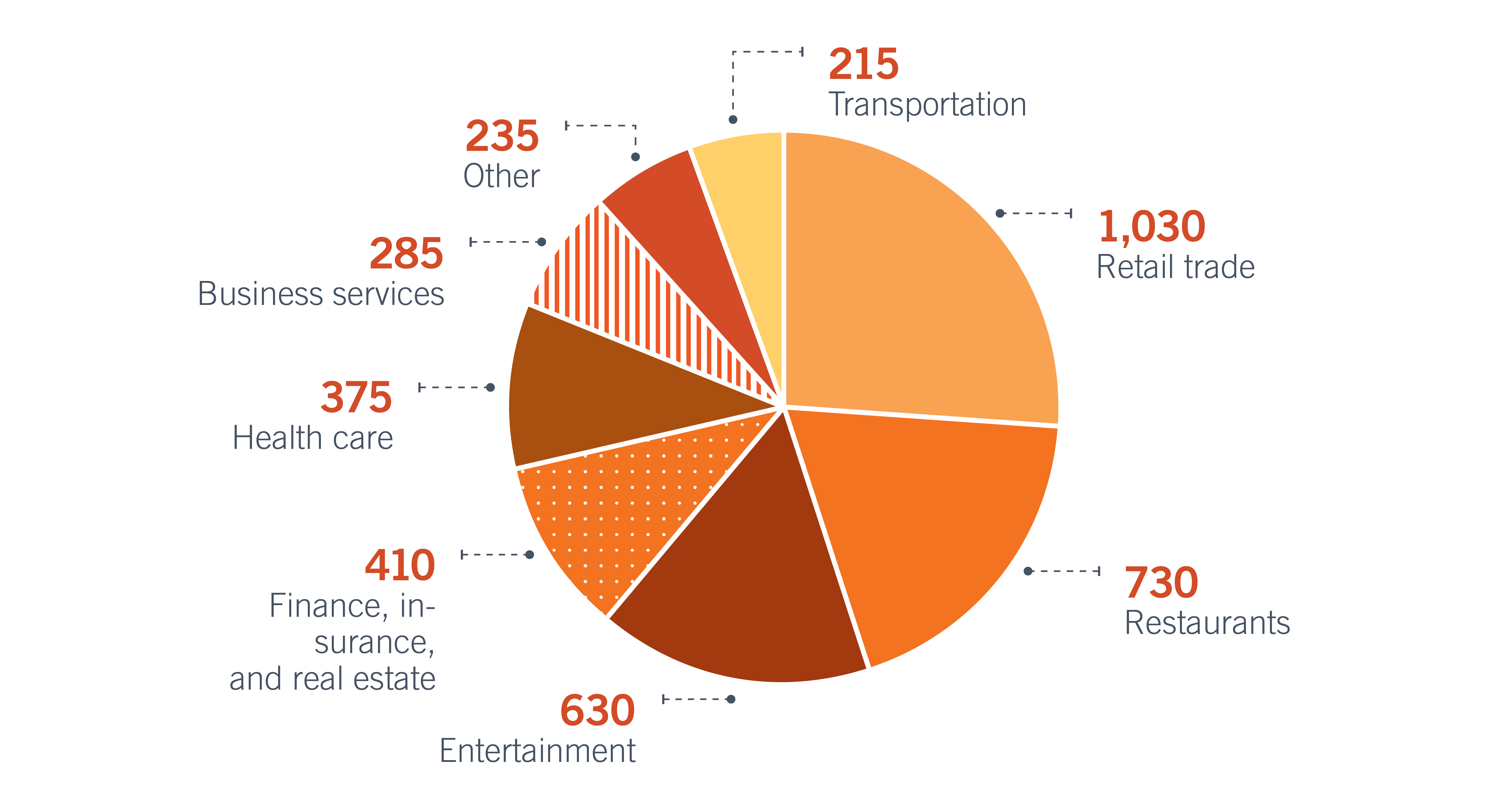
Those 3,910 jobs are found in many industry sectors:
| Industry | Jobs |
|---|---|
| Retail Trade | 1,030 |
| Restaurant | 730 |
| Entertainment | 630 |
| Finance, Insurance, & Real Estate | 410 |
| Healthcare | 375 |
| Business Services | 285 |
| Transportation | 215 |
| Other | 235 |
Tri-state jobs created by UW-Platteville alumni by industry
Impact of alumni earnings on Wisconsin
Looking at the same data set but specifically for Wisconsin alone, 60% of survey respondents (which represent 18,000 of UW-Platteville’s 30,000+ graduates) continue to live and work in Wisconsin. The benefits of a university degree are felt not only in the UW-Platteville graduate’s pocketbook, but also in the state’s treasury. Based on estimates of workforce participation rates, in-state UW-Platteville alumni residents earn more than $1.7 billion annually in personal income. These alumni also contribute $83 million more annually in state income and sales taxes than residents without a college degree. The additional earnings past those of high school graduates also generate over $550 million a year in economic impact:
| Type of Effect | Employment | Labor Income | Output |
|---|---|---|---|
| Direct Effect | 2,115 jobs | $91,000,000 | $300,000,000 |
| Indirect Effect | 570 jobs | $38,000,000 | $140,000,000 |
| Induced Effect | 615 jobs | $35,000,000 | $111,000,000 |
| Total Effect | 3,300 jobs | $164,000,000 | $551,000,000 |
| Industry | Jobs |
|---|---|
| Retail Trade | 865 |
| Restaurant | 615 |
| Entertainment | 525 |
| Finance, Insurance, & Real Estate | 345 |
| Healthcare | 315 |
| Business Services | 240 |
| Transportation | 180 |
| Other | 215 |
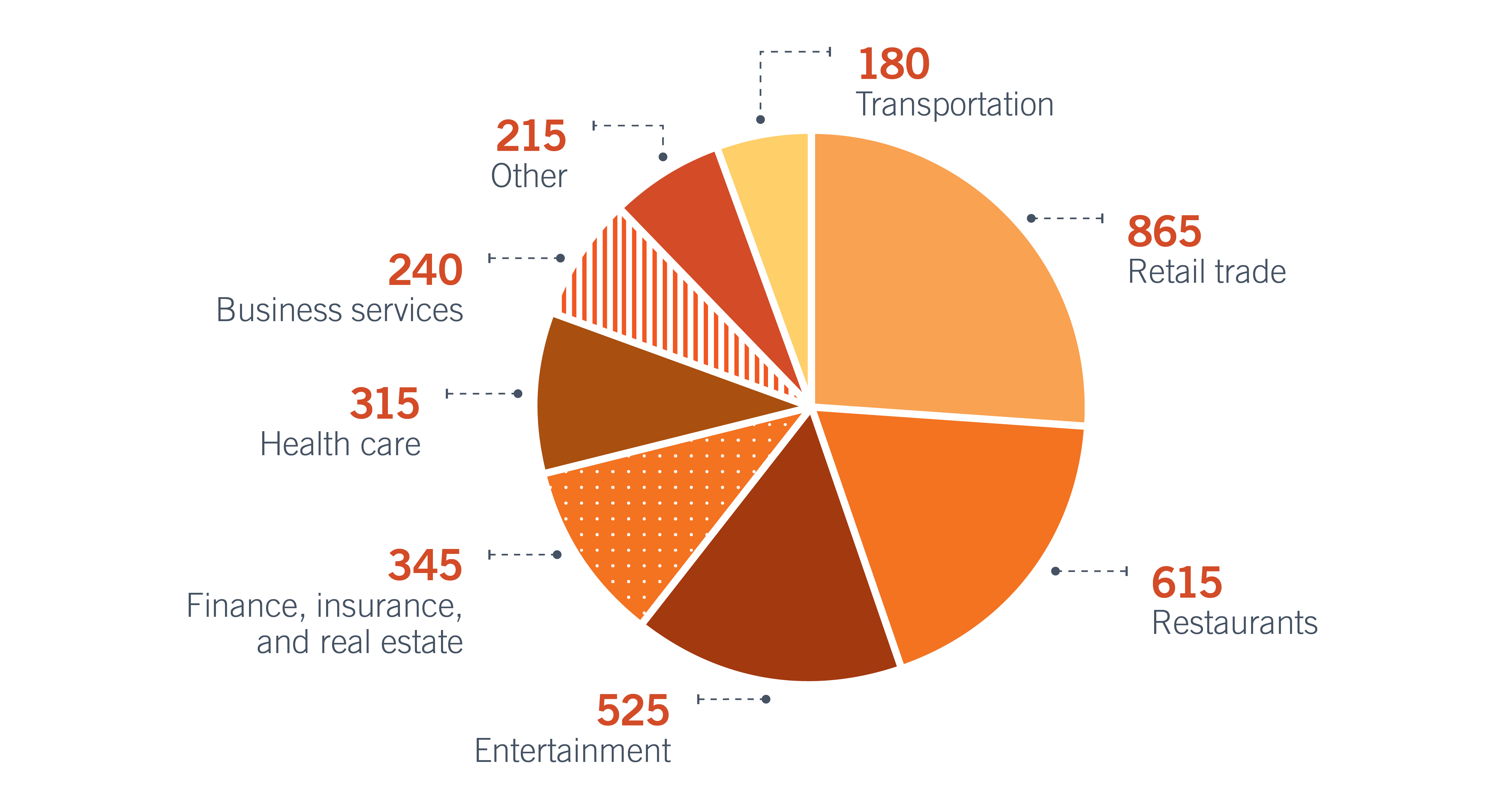
Wisconsin jobs created by UW-Platteville alumni by industry
Tax Impact
University of Wisconsin-Platteville graduates add to the state’s overall income and sales tax revenue. UW-Platteville graduates pay an additional $65 million annually in state income tax, and an additional $18 million annually in sales tax beyond that of the average taxpayer of a similar age with only a high school degree.
Financial Impact of Operations and Current Students
UW-Platteville has a considerable effect on the local economy, creating employment and economic demand in the area. University operations and student spending together account for most of the impact on the region, augmented by attendance at events and camps (including athletics). Altogether, UW-Platteville supports 1,585 jobs and leads to $297,700,000 in economic activity yearly. In addition to this regional impact, the economic activity resulting from UW-Platteville’s presence generates an estimated additional $15,500,000 yearly tax revenue for the state because of those jobs (income tax) and economic activity (sales tax). This is in addition to the $83 million of yearly Wisconsin tax revenue generated by increased income levels of UW-Platteville alumni living in Wisconsin.
FERC’s IMPLAN analysis resulted in the following measures of economic impact, both in the effect of students as additional residents in the area that drive economic activity, and in the effect of UW-Platteville operations itself.
| Type of Impact | Employment | Labor Income | Economic Output |
|---|---|---|---|
| Economic Impact of Students | 200 jobs | $10,350,000 | $42,700,000 |
| Direct Effect | 110 jobs | $4,850,000 | $23,800,000 |
| Indirect and Induced Effect | 90 jobs | $5,500,000 | $18,900,000 |
| Economic Impact of Operations | 1,385 jobs | $121,500,000 | $255,000,000 |
| Direct Effect | 815 jobs | $88,000,000 | $145,000,000 |
| Indirect and Induced Effect | 570 jobs | $33,500,000 | $110,000,000 |
| Total Economic Impact of UW-Platteville | 1,585 jobs | $122,535,000 | $297,700,000 |
| Industry | Jobs |
|---|---|
| Government/Education | 830 |
| Retail Trade | 140 |
| Restaurant | 105 |
| Finance, Insurance, & Real Estate | 140 |
| Healthcare | 100 |
| Business Services | 75 |
| Other | 195 |
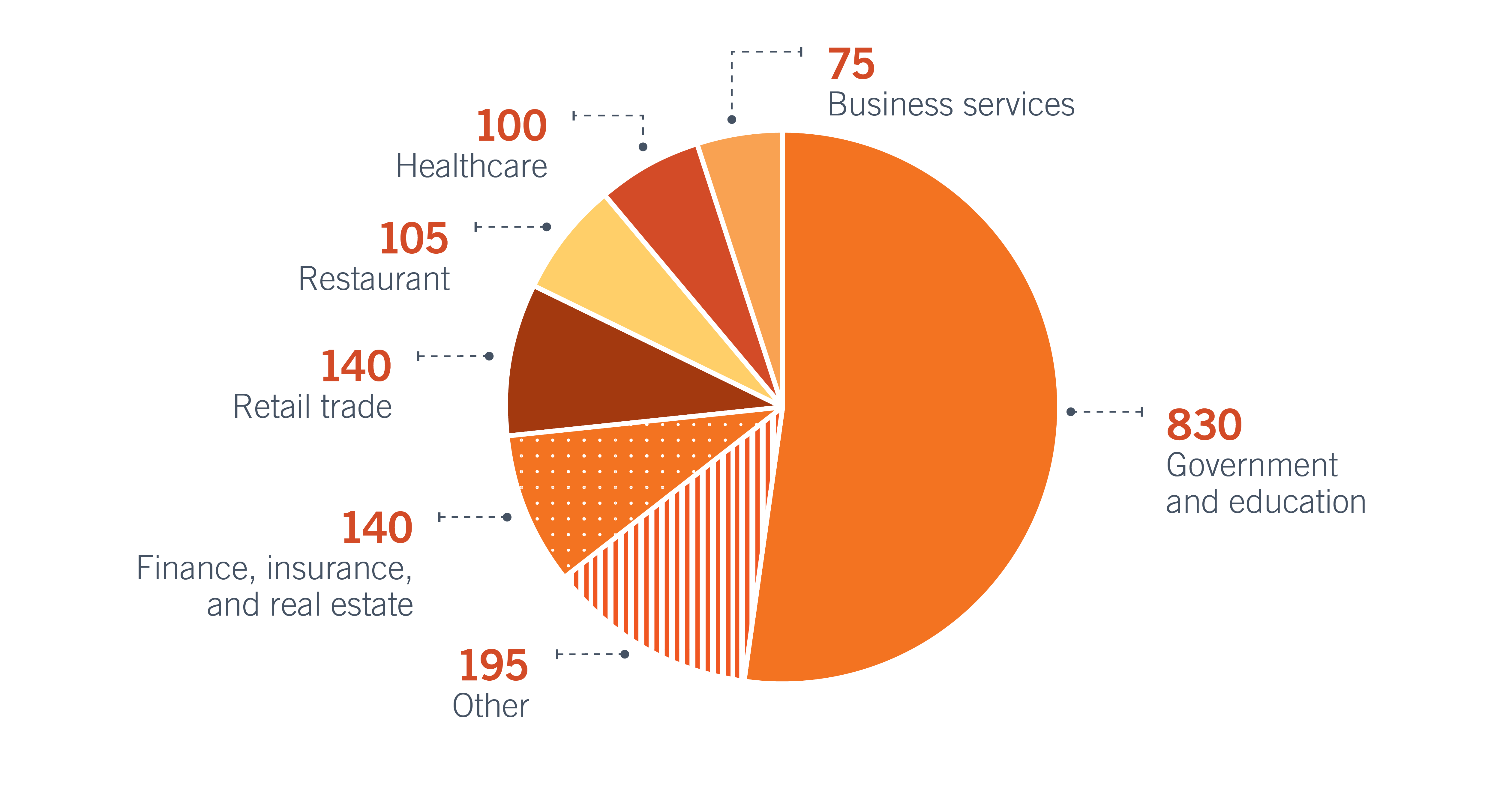
Jobs Created by Operations & Current Students by Industry
About UW-Platteville
Founded in 1866 as Wisconsin’s first teacher training institution, the University of Wisconsin-Platteville has evolved into a prominent four-year university known for academic excellence, affordability, and practical, hands-on learning. The university emphasizes real-world experience through partnerships with industry and community engagement, preparing students for high-demand careers.
UW-Platteville provides more than 40 academic programs across three colleges—Business, Industry, Life Science and Agriculture (BILSA); Engineering, Mathematics and Science (EMS); and Liberal Arts and Education (LAE). Students benefit from small class sizes, experienced faculty, and modern facilities, all within a supportive and inclusive campus environment. The university also features a vibrant student life with numerous organizations and NCAA Division III athletics. Committed to making quality education accessible, UW-Platteville offers some of the most affordable tuition rates and still fosters a student-centered experience. Under the leadership of Dr. Tammy Evetovich—appointed as the university’s 15th chancellor in April 2023—the institution continues to focus on student success by nurturing a culture dedicated to holistic student development and workforce readiness.
About the FERC
The University of Wisconsin-Whitewater Fiscal and Economic Research Center provides research services for area businesses, not-for-profit organizations and government entities.
ABOUT THE AUTHORS
Russ Kashian is a professor of economics at the University of Wisconsin-Whitewater. He served as a specialist for the University of Wisconsin-Extension and is the director of the Fiscal and Economic Research center at UW-Whitewater. In the 20 years that he has taught at the university, his focus has been conducting applied research projects that develop students, are of value to others, and serve the region. Dr. Kashian’s main areas of interest are financial intermediaries, tourism, education, and economic development.
Phone: 262.472.5584
Email: kashianr@uww.edu
Caryana Dominguez is a data analyst and technical writer at the FERC and undergraduate student at the University of Wisconsin-Whitewater
1FERC drew Data from the BLS Current Population Survey, inflation adjusted to 2025 and further adjusted to the Midwest Region using the Midwestern Higher Education Compact report to the 78th Midwestern Legislative Conference, 2024.
2https://docs.legis.wisconsin.gov/misc/lc/study/2024/2699
3FERC drew Data from the BLS Current Population Survey, inflation adjusted to 2025 and further adjusted to the Midwest Region using the Midwestern Higher Education Compact report to the 78th Midwestern Legislative Conference, 2024.
4https://docs.legis.wisconsin.gov/misc/lc/study/2024/2699