
Genghis Khan in Wisconsin: UW-Platteville Students Explore the Riches of Central Asia on a Field Trip
Genghis Khan (born Temujin, 1162-1227) was a world-famous conqueror. His armies captured vast expanses of territory, reaching as far as Korea in the east and Germany in the west. He and his sons unified different civilizations in Eurasia, creating a common sphere for trade, intellectual exchange, and postal communication. And one of his coins ended up in Wisconsin.
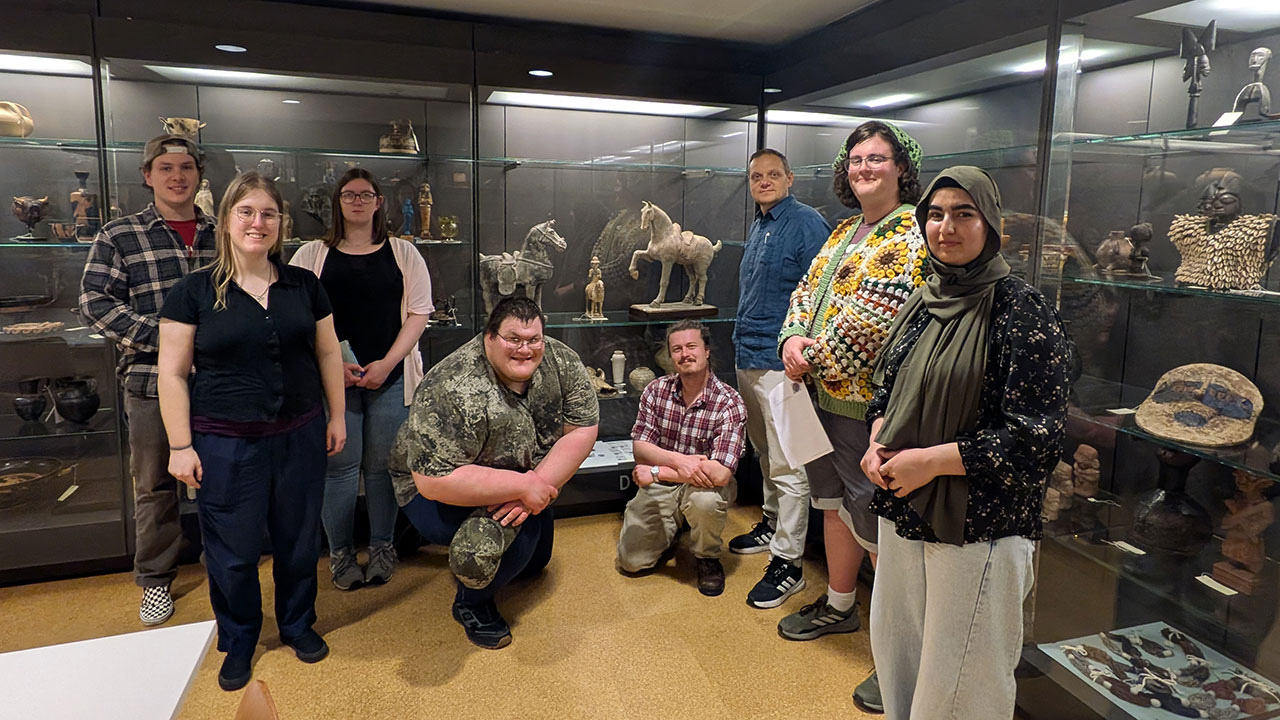
To explore the famous coin of Genghis Khan and various other treasures from Central Asia, seven UW-Platteville students travelled to the Chazen Museum of Art in Madison on April 16, 2026. The field trip was organized by Prof. Andrey Ivanov, as a part of his HIST 4130 Central Asia class. The visit to the Chazen Museum was graciously organized by Mieke Miller, Chazen’s academic coordinator, who made the artefacts available to the class.
Among the riches of Central Asia, now stored at the UW Chazen Museum, are the 16th century Persian miniature paintings, medieval manuscripts with poetry of Hafez, Iranian Jewish ceremonial plates and vessels, as well as Mongolian and Tibetan Buddhist art.
“I am very grateful to UW Chazen Museum, and particularly to Mieke Miller, for making this thrilling experience available to my students,” said Ivanov. “While we can’t go back in time to see Genghis Khan or Hafez, exploring the past by studying material culture and artefacts by tactile and tangible inquiry is the closest thing we have to a time machine.”
After the Chazen Museum seminar, students met with UW-Madison instructor of Kazakh languages and literature Gulnara Glowacki to learn more about the languages and cultures of Central Asia. Then, they whizzed out to the Pyle Center, for the Annual Endowed Petrovich Lecture in Russian and Soviet History, delivered by the University of Pennsylvania professor Benjamin Nathans. The lecture explored the origins and the rise of the Soviet dissident movement, which resisted Communism, and played a part in the downfall of socialism in Eurasia, including Kazakhstan.
The students who attended are: Broderick Livermore, Benjamin Blanke, Freshta Sahak, Josephine Kallal, Langdon Everson, Merlin Larsen, Sophia Hlavac.